
A history of polyurethane foam: from the 1937 laboratory to the block in the warehouse
TechnicalOctober 28, 2026
How an attempt to get around the nylon patent produced a material we touch a dozen times a day - and what actually happens in the mould when two liquids become a block.
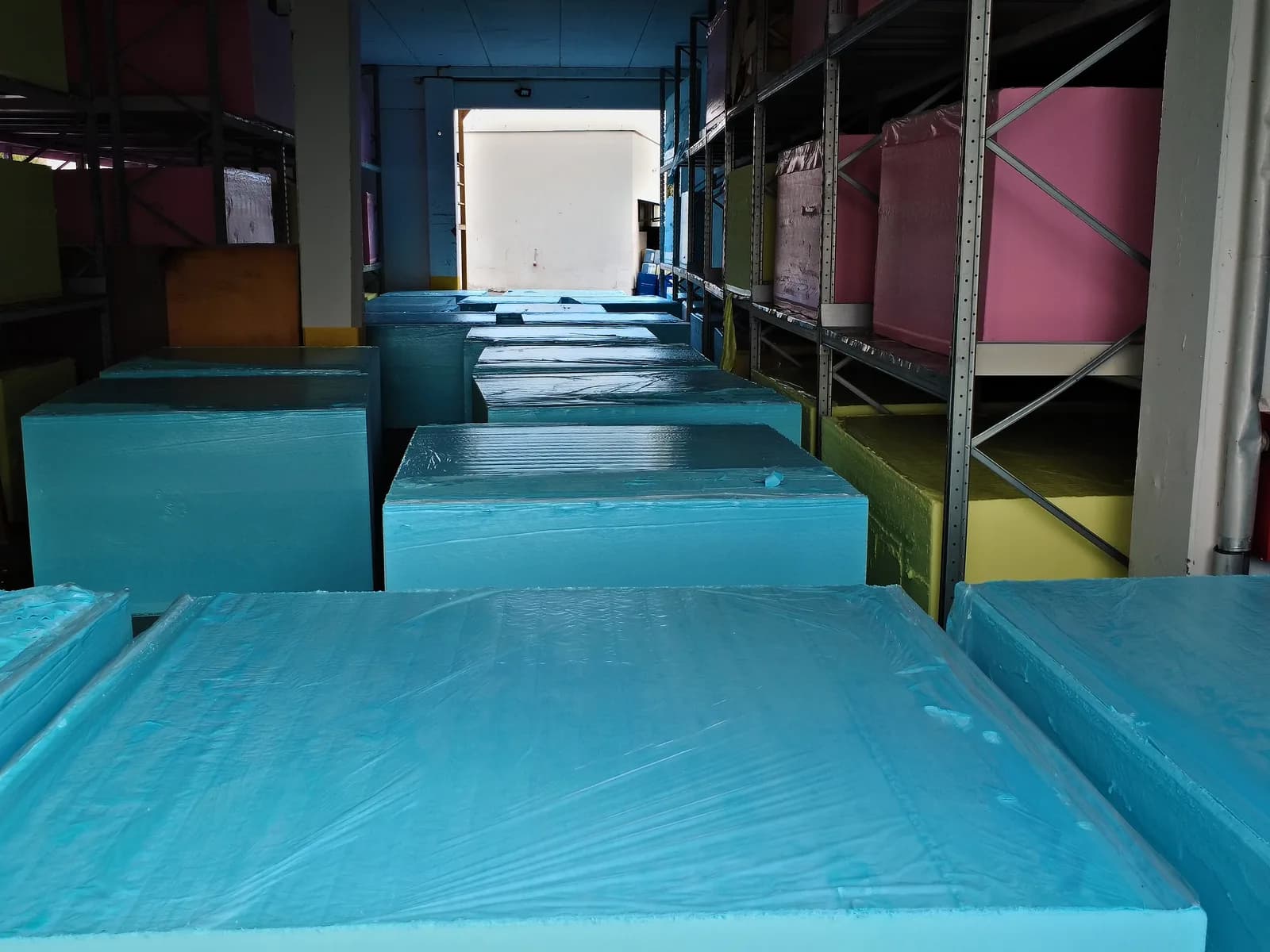
Flexible polyurethane foam is a material most people touch a dozen times a day without ever looking at it. A car seat, a sofa cushion, a mattress, the sponge at the sink, acoustic panels in a studio - all the same chemical family, born from a reaction first described in 1937.
This is the story of how it came about, why it looks the way it does, and what actually happens in the mould when two liquids become a block big enough to hold a person.
1937: a reaction looking for a use
In 1937, at IG Farben in Leverkusen, Otto Bayer was working on a very concrete industrial problem: DuPont had patented nylon and closed that route to European fibre makers. Bayer's team went another way - instead of polyamides, they combined diisocyanates with polyols.
What they got was not a particularly good fibre. It was something else.
The reaction was not discovered in order to make foam. Foam was a side effect that still had to be understood.
The key is that an isocyanate does not only react with the alcohol group of a polyol. It also reacts with water - and that reaction releases carbon dioxide. Add a small amount of water and the polymer builds itself while filling with bubbles of gas it produces on its own. The material expands several times in volume as it hardens.
That is the whole secret of foam: polymerisation and foaming happen at the same time, in the same vessel, and must be matched to the second.
What actually happens in the mould
If the reaction runs too fast, the foam sets before it reaches the top of the mould and stays heavy and dense. Too slow, and the gas escapes before the polymer forms, so the block collapses into itself. The entire craft lies between those two failures.
Which is why the mix is never just two components:
- Polyol - the base component, carrying the structure of the future polymer
- Isocyanate (TDI) - the reactive partner that builds urethane bonds
- Water - the blowing agent; with isocyanate it yields the CO₂ that raises the block
- Catalysts - one accelerates rise, the other cure; their ratio decides whether those two curves meet at the right moment
- Silicone stabilisers - keep bubbles from merging into large voids before the walls harden
- Colourants and additives - grade identification, protection against ageing
Why the blocks are colourful
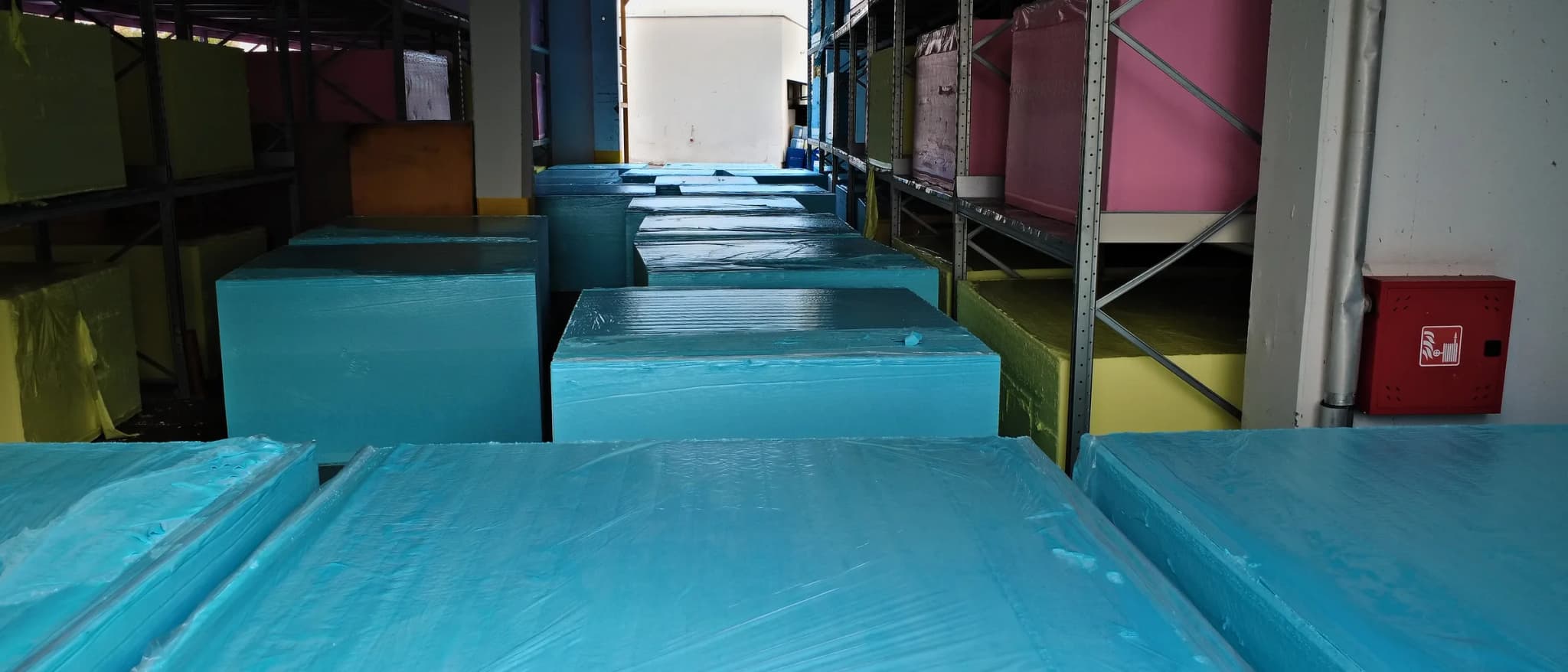
This is usually the first question visitors ask. The pink, green, turquoise and purple blocks in the warehouse are not there for looks - colour is an industrial grade marker.
In a warehouse holding several hundred cubic metres of foam, a worker has to tell 21 kg/m³ foam from 35 kg/m³ at a glance. By touch they are similar; by eye, identical. Colour solves that without a single label.
That is why the same grade sometimes comes in several colours - one industry asks for pink, another for green, and the material is the same. Colour is part of the article code, not a product variant.
The 1950s: foam becomes an industry
For its first fifteen years polyurethane was a laboratory curiosity and a material for coatings and adhesives. Only in the mid-1950s did equipment appear that could reliably mix the components at industrial volumes and pour them into a mould.
That is when what is still called the batch (discontinuous) process emerged: a measured quantity of mix is poured into a mould - a large rectangular box - the reaction starts, the foam rises to the top and cures there. Once the block is removed, the mould is cleaned and the cycle begins again.
The 1960s and 1970s: cold-cure foam
For a long time all flexible foam was what is now called standard or "hot" foam. Its weakness was recovery - after a long load the cushion stayed slightly compressed.
In the 1970s came high-resilience foam (HR), made by cold curing with different polyols. Its cells are more irregular, and the material returns faster and more completely after compression.
That is why car seats and better mattresses almost always use HR: a seat is compressed tens of thousands of times over a vehicle's life, and every lost percentage of recovery eventually shows as a sag.
The 1980s and 1990s: the end of CFCs
One chapter of the industry sounds unbelievable today: for decades chlorofluorocarbons (CFCs) were used as auxiliary blowing agents. They were cheap, non-flammable and gave a fine cell.
They were also a principal cause of ozone layer damage.
The 1987 Montreal Protocol began their phase-out, and the foam industry had to rewrite its formulations. The answer was ultimately a return to basics - water as the main blowing agent, with adapted catalysts and stabilisers. The overwhelming majority of today's flexible slab foam is water-blown, using CO₂ generated by the reaction itself.
Safety: TDI is not harmless
An honest account of foam has to say this too: TDI (toluene diisocyanate) is a hazardous substance. It is volatile, irritates the airways and can cause sensitisation. It is not present in finished, fully reacted foam - but it is present in a plant where it is stored and dosed.
That is why facilities handling larger quantities of isocyanate fall under the EU Seveso directive, with prescribed procedures for storage, dosing and incident response. The plant in Bjelavići near Kakanj operates under that regime.
That is not a marketing point but an obligation - and the reason foam production is not a business you open in a garage.
How to read a grade code
This is the most useful part of the article for anyone ordering foam. The code is not a catalogue reference - it carries data:
| Code | Density | Hardness | Meaning |
|---|---|---|---|
| PT 1830 | 18 kg/m³ | 3.0 kPa | first two digits = density, second two = hardness ×10 |
| PT 2541 | 25 kg/m³ | 4.1 kPa | denser and firmer than the above |
| PN 3540 | 35 kg/m³ | 4.0 kPa | high density, medium hardness |
| HR 3535 | 35 kg/m³ | 3.5 kPa | high-resilience - softer to the touch, better recovery |
The letters denote the family: PN standard, PT firm, PP extra firm, HR high-resilience, PE special purpose.
It is important to understand that density is not hardness. Density says how much material there is per cubic metre and relates to durability; hardness says how strongly it resists pressure. Foam can be dense and soft - and that is often exactly what a good mattress needs.
Where the industry is going
Three directions are real rather than promotional:
- Bio-polyols - part of the polyol comes from plant oils instead of petroleum. The share is still limited because properties must stay the same.
- Mechanical recycling (rebond) - cutting offcuts are shredded and pressed into high-density blocks for sports flooring and insulation. This is standard practice, not an experiment.
- Chemical recycling (glycolysis) - breaking old foam back down to polyol. Technically proven, not yet economically widespread.
The biggest contribution still comes from where nobody advertises it: less waste at cutting. A block cut to the customer's drawing, rather than cut to size and then trimmed, leaves considerably less offcut.
Plama-pur: from Podgrad to Kakanj
Plama-pur d.d. of Podgrad, Slovenia, has worked with polyurethane foam since the middle of the last century. Plama-pur BH d.o.o. in Kakanj is a 50/50 joint venture with that company - so neither an agency nor resale, but production with transferred experience.
In practice that means the technical data a customer receives with a quote comes from a batch made in Bjelavići, not from somebody else's catalogue.
Glossary
- Polyol - base component, carries the polymer structure
- Isocyanate / TDI - reactive partner; builds urethane bonds
- Blowing agent - substance creating gas; today mostly water
- Density (kg/m³) - mass of material per cubic metre; relates to durability
- Hardness CLD (kPa) - resistance to pressure at 40% compression
- Compression set - how much foam stays compressed after a long load
- Rebond - block pressed from shredded foam offcuts
- Batch process - foaming in a mould, block by block
What next
If you know which properties you need, the foam catalogue carries density and hardness for every article. If you are not sure, describe the application in an inquiry - we propose a grade and confirm it fits before you order.
How a block is made, step by step, is explained on the technology page.
Have a specific case?
Send dimensions, quantity and intended use - we propose a foam grade and send a quote or sample.
Send an inquiry