
Quality and control: where foam is really decided
TechnicalOctober 28, 2026
A block looks the same whether the formulation was respected or not - the difference shows up at the customer. So we measure three times, and the most important measurement is not the last one.
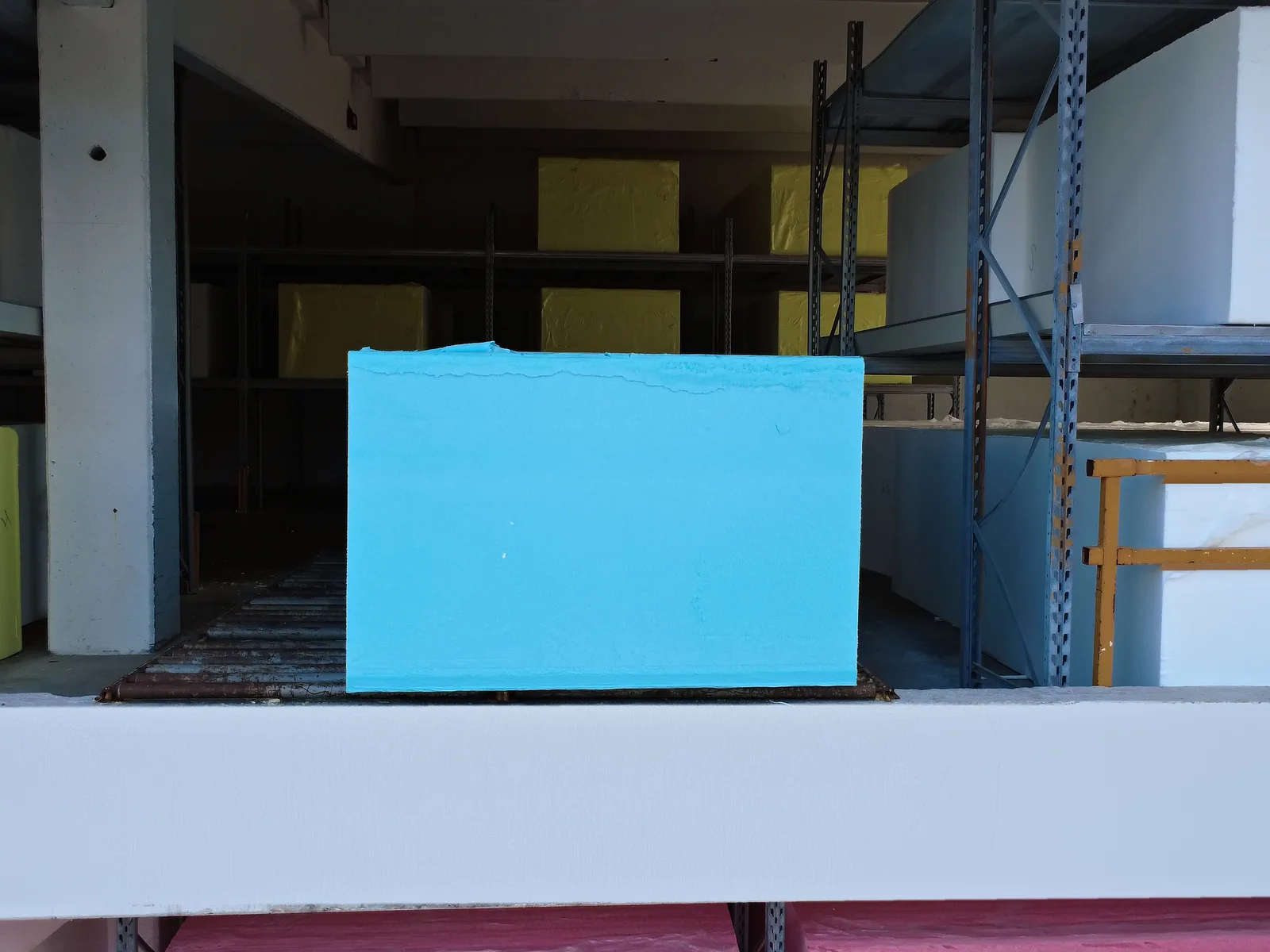
With foam it is easy to promise quality and hard to prove it. A block looks the same whether the formulation was respected or not - the difference only shows up at the customer, after a few months of use, when a cushion begins to sag or sheets fail to match inside a panel.
That is why quality control in foam is less about a final inspection and more about discipline at every stage. This text explains where exactly we measure, what we measure, and why those particular numbers.
Quality is measured three times, not once
In practice there are three points at which a bad batch can be prevented. Miss the first and the second gets expensive; miss the first two and the third merely records the damage.
- Incoming - raw materials. Polyol, isocyanate, catalysts and additives are received with supplier documentation and stored under prescribed conditions.
- In-process - formulation and foaming parameters. The ratio of components and the conditions under which the reaction runs determine everything that can be measured later.
- Outgoing - the finished block. Density, hardness and dimensions of every batch.
Foam cannot be "fixed" once it has cured. The only thing that can be done is not to let it go any further.
Why the second step matters most
Most people assume final inspection is the decisive step. With polyurethane it is not - the decisive step is dosing.
The reason lies in the reaction itself: the polymer builds while the foam rises, simultaneously. The ratio of components decides whether those two events meet at the right moment. Too little catalyst and the block collapses into itself; too much and the foam sets before reaching the top of the mould. Neither failure can be corrected afterwards.
Density and hardness are therefore not adjusted at the end - they are decided the moment the valves open.
What exactly we measure
Density (kg/m³)
Mass of material per cubic metre. This is the number that says most about durability: lower-density foam fatigues faster under the same load. In our range densities run from 18 to 40 kg/m³.
A common misconception: density is not hardness. Foam can be dense and soft - and that is often exactly what a good mattress needs.
Compression hardness (CLD, kPa)
How strongly the foam resists pressure when compressed to 40% of its thickness. This is the number a customer feels by hand. Hardness in our range runs from 2.0 to 5.0 kPa.
Tensile strength and elongation
How much force the foam takes before it tears and how far it stretches first. This matters for applications where foam is pulled or tensioned - upholstery, lamination, footwear. Foam of good density but poor tensile strength will tear at cut edges.
Compression set
How much the foam stays compressed after a prolonged load. This is the most important number for a mattress and a car seat and at the same time the one a customer cannot verify on a sample - it only shows after months of use.
How to read a grade code
An article code is not a catalogue reference - it carries measured data:
| Code | Density | Hardness |
|---|---|---|
| PT 1830 | 18 kg/m³ | 3.0 kPa |
| PT 2541 | 25 kg/m³ | 4.1 kPa |
| PN 3540 | 35 kg/m³ | 4.0 kPa |
| HR 3535 | 35 kg/m³ | 3.5 kPa |
The first two digits are density in kg/m³, the second two are hardness multiplied by ten. The letters denote the family: PN standard, PT firm, PP extra firm, HR high-resilience, PE special purpose.
This is not only practical - it is a form of transparency. The code itself tells the customer what they are ordering, without having to request a data sheet.
What a certificate states, and what it does not
An honest note is needed here. The tensile and compression-set values on quality certificates stand as a requirement the grade must meet, not as the result of measuring the specific batch you received.
That is common in the industry and is not a shortcoming - but it is a distinction worth understanding:
- Requirement means: the grade is defined such that it must meet this value.
- Measurement means: this specific batch was tested and gave this result.
If your project needs a measurement of the specific batch, that is agreed with the order. We will not present a requirement as a measurement.
Colour as part of control
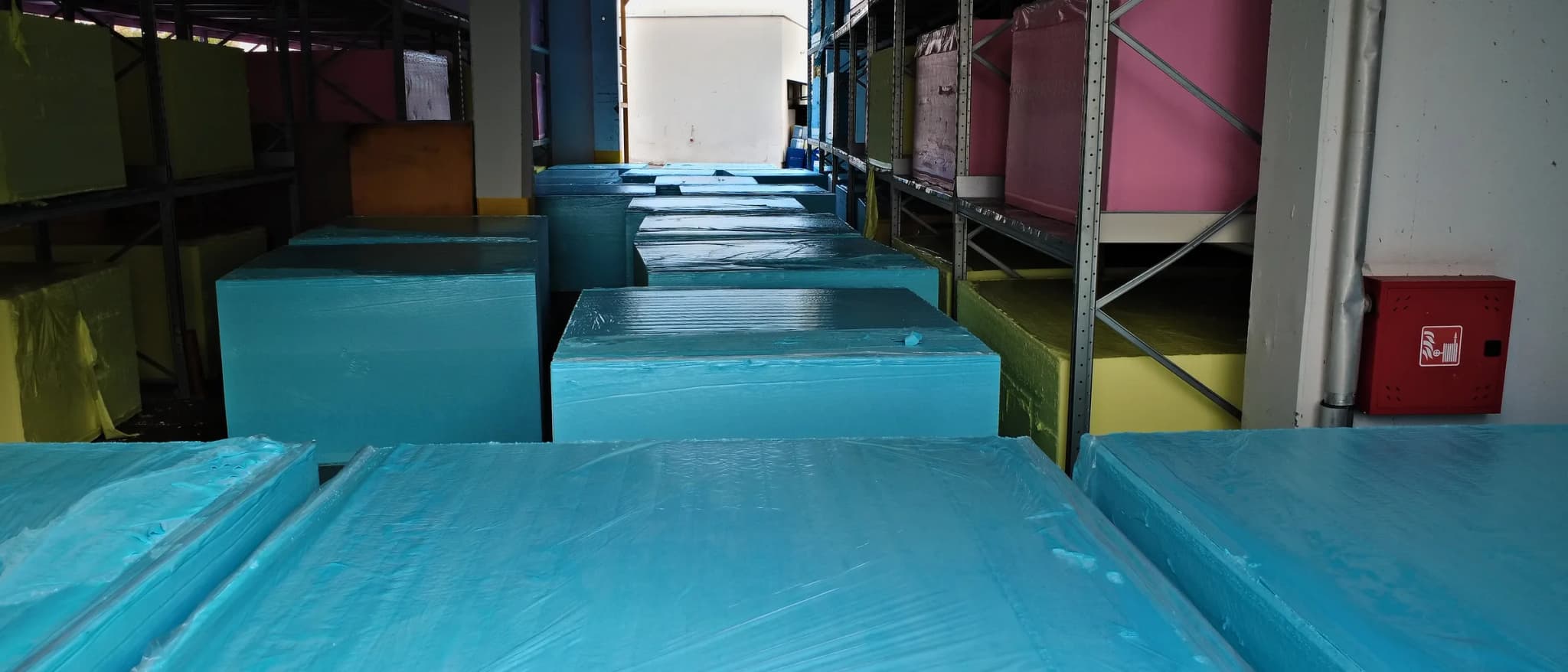
Visitors usually read the colourful blocks in the warehouse as aesthetics. They are in fact part of the control system.
In a warehouse holding several hundred cubic metres, a worker must tell 21 kg/m³ from 35 kg/m³ at a glance. By touch they are similar; by eye, identical. Colour solves that without a label that can fall off or be swapped.
That is why colour is part of the article code (`PN 3540 CRVENA`) rather than a product variant - and why the same grade comes in several colours.
Safety is part of quality
Working with isocyanates is not the same as working with an inert material. TDI is a hazardous substance: volatile, an airway irritant, and capable of causing sensitisation. It is absent from finished, fully reacted foam - but present in a plant where it is stored and dosed.
That is why the plant in Bjelavići operates under the Seveso regime, with prescribed procedures for storage, dosing and incident response. This is not an addition to quality but its precondition: a process that is not safe is not stable either.
What is not published yet
Part of the documentation is in preparation, and the quality page says so openly:
- Cutting tolerance table - will be published in table form once technical documentation is provided. Until then tolerances are agreed with the quote, per application.
- Certificates with numbers and scans - will be published when ready for public release.
We would rather write that something is not published than guess. If you need a specific figure before it appears on the site, ask in an inquiry - you will receive it with the quote.
What this means for you as a buyer
Three practical points:
- Ask for both numbers, not one. Density without hardness (or the reverse) does not describe foam. The grade code gives you both.
- For mattresses and seating, ask about compression set. It is the only number that predicts how the material will look in two years.
- A sample is the fastest hardness check. The numbers are accurate, but hardness by hand is subjective - and a sample is a free part of the conversation.
The catalogue with data for every article is on the foam grades page, and how a block is made is explained under technology.
Have a specific case?
Send dimensions, quantity and intended use - we propose a foam grade and send a quote or sample.
Send an inquiry