
How to read foam grade designations
TechnicalJune 30, 2026
HR-3530, VE-5015, N-2540 - a grade designation carries the family, density and hardness. How to decode it, and why designations from different producers are not comparable.
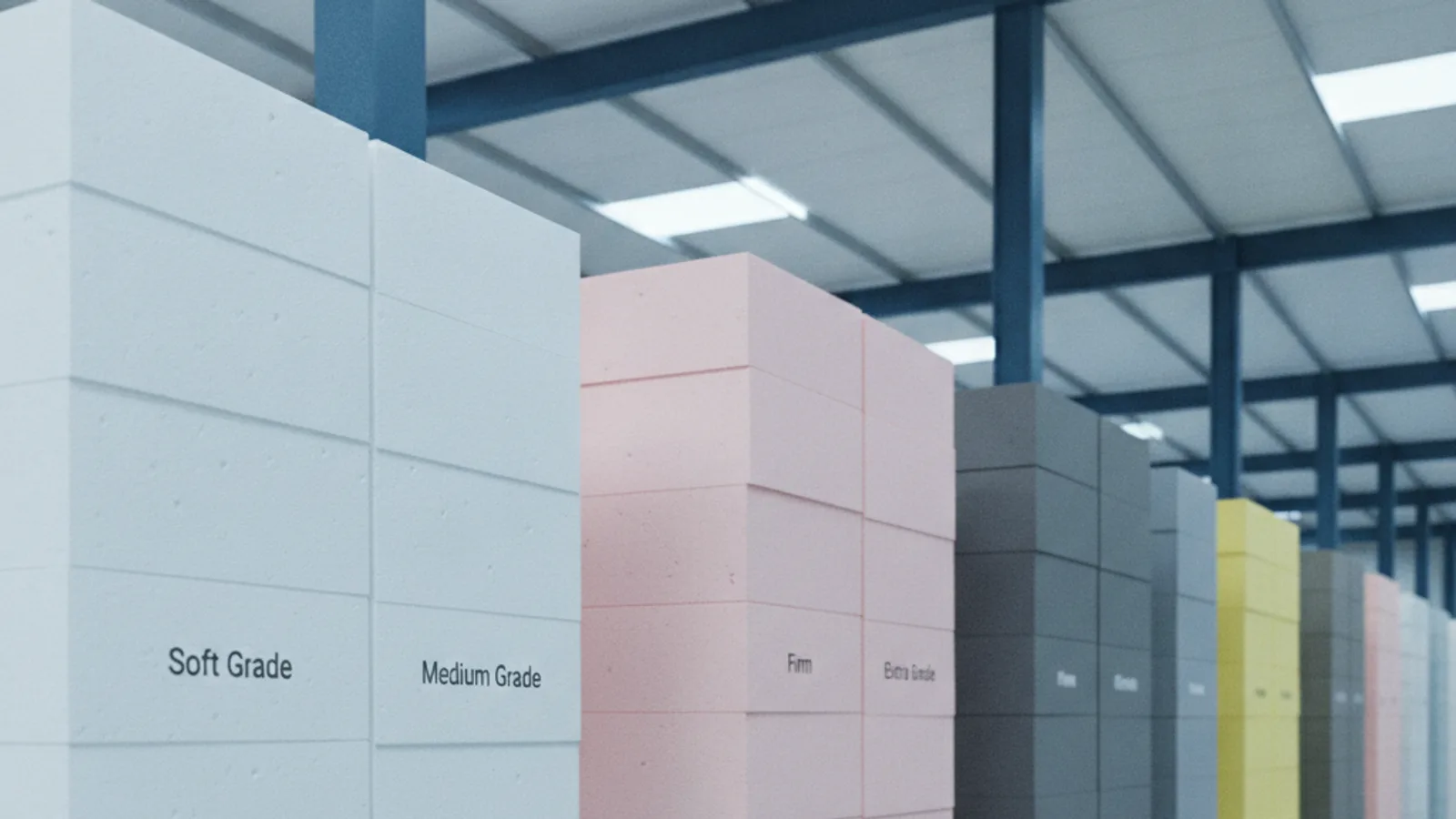
Foam grade designations look like ciphers, but with most producers - including us - they follow a simple pattern.
The pattern
Our designations read: family prefix + density + hardness.
| Part | Meaning | Example |
|---|---|---|
| Prefix | foam family | N, HR, VE, CM, ES, RB, CL, SP |
| First digit group | density (kg/m³) | 35 |
| Second digit group | hardness CLD ×10 (kPa) | 30 → 3.0 |
Examples from our range
- N-2540 - conventional ether foam, 25 kg/m³, CLD 4.0 kPa.
- HR-3530 - high resilience foam, 35 kg/m³, CLD 3.0 kPa.
- VE-5015 - viscoelastic (memory), 50 kg/m³, CLD 1.5 kPa.
- RB-9015 - rebond (bonded granulate), 90 kg/m³, CLD 15 kPa.
Family prefixes: N conventional ether, ES ester, HR high resilience, VE viscoelastic, CM combustion-modified (CMHR), RB rebond, CL coloured foam, SP special foams.
Why designations are not universal
No standard prescribes the designation format - every producer chooses their own. Someone else's "N2540" may mean a different hardness, a different test method or a different formulation. Therefore:
- Compare grades by the technical data sheet, never by designation.
- When replacing a material, request the TDS of both the old and the new grade.
- If an inherited specification lists only a designation without a TDS, send it to us - we will propose the closest equivalent from our range.
Have a specific case?
Send dimensions, quantity and intended use - we propose a foam grade and send a quote or sample.
Send an inquiry