
Recycling PU waste and rebond - the second career of cutting offcuts
TechnicalMarch 10, 2026
Contour cutting leaves a significant share of offcuts - and they don't go to landfill. How rebond is made and where bonded granulate beats ”real” foam.
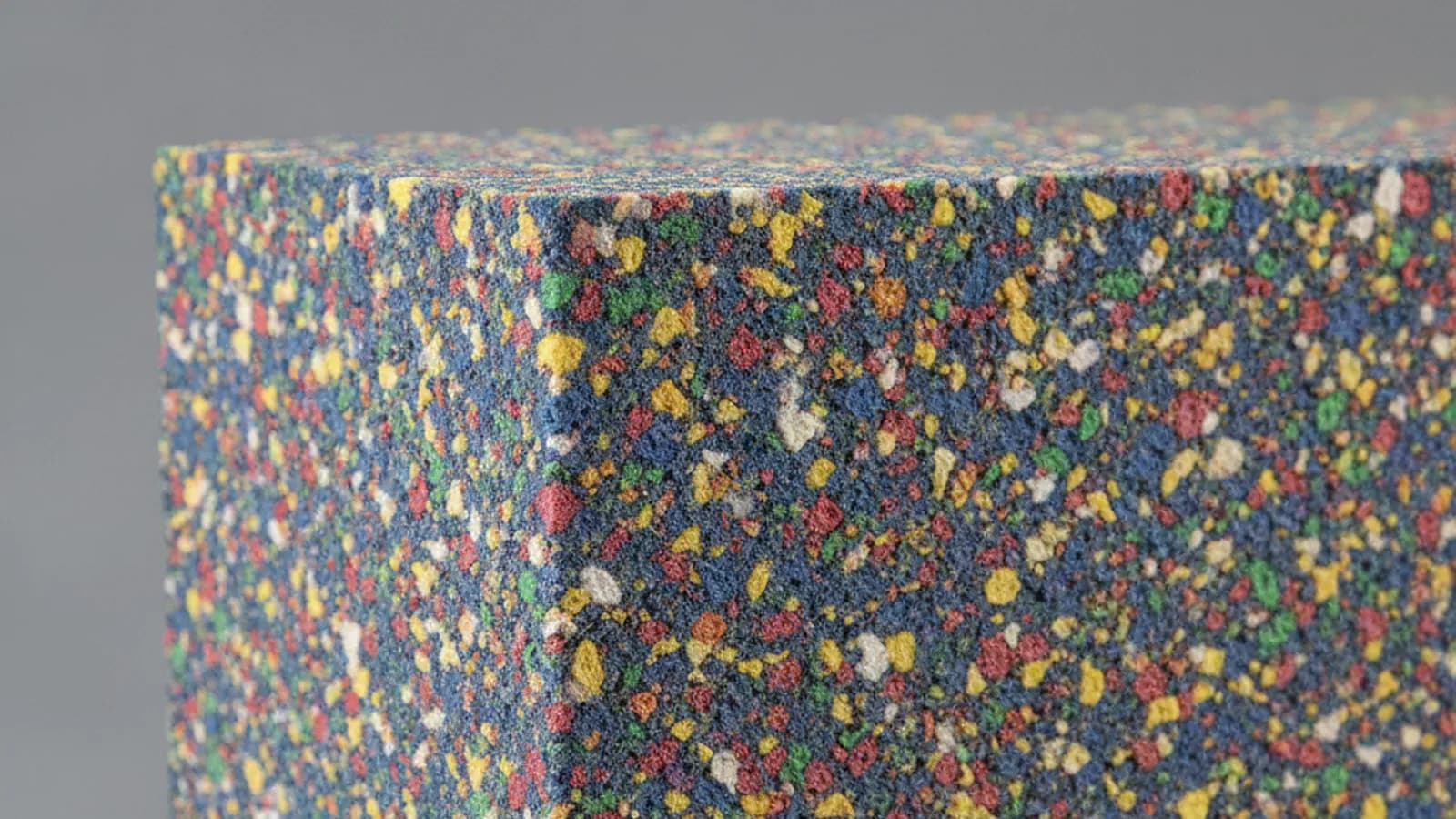
Every foam conversion leaves offcuts: block edges, trial cuts, contour-cutting waste. In the flexible foam industry this material has a well-established second career.
Rebond - mechanical recycling that works
The process is simple and industrially mature:
- Offcuts are shredded into granulate a few millimetres in size.
- The granulate is mixed with a PU binder and compressed in a mould.
- The result is a block of 60–120 kg/m³ - several times denser than the source foam - which is then cut like any other.
Rebond blocks are recognisable by their multicoloured structure, as the granulate comes from foams of different colours.
Where rebond beats primary foam
- Sports surfaces: gyms, fitness floors, protective linings - the high density gives impact resistance primary foam cannot deliver economically.
- Flooring underlays: under laminate and carpet, as acoustic and thermal insulation.
- Vibration isolation of machines and equipment.
- Seating that requires very high load capacity.
Other routes for PU waste
- Energy recovery - controlled incineration with energy utilisation, for material that cannot be mechanically recycled.
- Chemical recycling (glycolysis) - breaking foam back down into polyol components; a technology maturing industrially, with the first commercial plants in Europe.
What this means for customers
Your cutting waste need not be a cost: for larger volumes of contour waste, material take-back can be arranged. And if your product can live with rebond, you get a denser material at a lower price - ask us whether your application fits.
Have a specific case?
Send dimensions, quantity and intended use - we propose a foam grade and send a quote or sample.
Send an inquiry